





A practical guide for Indian students and parents exploring graphic design after 10th, covering portfolios, college applications, career clarity, and the smartest first step into design.
SUMMARISE WITH:


A practical guide for Indian students and parents exploring graphic design after 10th, covering portfolios, college applications, career clarity, and the smartest first step into design.
You just finished Class 10. Or you're in Class 11. Or you're approaching Class 12. You're interested in design, but you don't actually know if it's a viable career. Your parents are worried it isn't "stable". And every article you've found on a design course after Class 10 in India has pushed you toward one of two extremes. A four-year design degree at NID, NIFT, Srishti, or MIT Institute of Design (huge commitment, expensive, possibly the wrong call). Or a free YouTube playlist (zero rigor, no real feedback, no portfolio to show for it).
There's a third option that almost nobody writes about. A short, serious, paid intro course in graphic design fundamentals that you can take across Class 11 or Class 12, alongside your regular coursework or Board prep. It does three things at once. It lets you actually test whether design is for you with real work and real critique. It produces portfolio pieces that strengthen your college applications, including applications to non-design programs. And it costs a fraction of a single semester at most Indian design colleges.
This guide is written for students in Class 11 and Class 12 who are considering design, and for the parents reading over their shoulders. We won't pretend design is easy or that everyone who tries it will love it. We'll just tell you what a serious first step actually looks like in India in 2026, and exactly when in your school years to take it.
- Why Free Design Tutorials on YouTube Don't Actually Test Your Fit
- How a Real Graphic Design Course Tests Your Fit for the Field
- How a Graphic Design Course Strengthens Your College Application (Even If You Don't Pursue Design)
- Three Timing Windows for Taking a Design Course in Class 11 or 12
- How a Graphic Design Course Strengthens Your College Application (Even If You Don't Pursue Design)
- Why Graphic Design Skills Are Useful in Any Career, Not Just Design
- How to Convince Your Parents About Taking a Design Course (and What to Show Them)
- Frequently Asked Questions
- Key takeaways
TL;DR: Watching YouTube will not tell you if design is the right career. Jumping straight into a four year degree is too risky. The smartest move is a short fundamentals course with real teacher feedback. Take it during Class 11 to build a strong college portfolio and see if you actually like the work before making a huge choice.
Why Free Design Tutorials on YouTube Don't Actually Test Your Fit
The most common advice for someone in your position is to explore design on YouTube first. It sounds reasonable. It’s mostly wrong.
YouTube can show you what design output looks like. It can teach you basic Figma or Photoshop button-pushing. What it cannot do is give you the one thing that tells you whether you’d be good at the field. Real critique on real work that you made.
Without that critique, you’ll never know whether what you produced is actually strong, mediocre, or weak. You’ll watch someone make a logo in twenty minutes. You’ll try one yourself. You’ll think it looks fine. And you’ll have learned almost nothing about your actual fit for the discipline.
Design judgment doesn’t come from watching. It comes from making, getting told honestly where your decisions were weak, and then making it again. That loop is what turns a curious 16 year old or 18 year old into someone who knows whether they have the temperament for design work. There’s no shortcut to it.
This is why the right first step isn’t more free content. It’s a structured course with a faculty member who looks at your work and tells you the truth.
How a Real Graphic Design Course Tests Your Fit for the Field
A serious graphic design fundamentals course (three to six months, paid but not expensive, taught by working designers) puts you in the position designers actually work in.
You receive a brief. You don’t fully understand it. You make a first attempt you think is good. A faculty member reviews it and tells you, in detail, why three of your decisions were wrong. You revise. You revise again. By the third revision, you start to develop the most important thing a designer has. Judgment.
In three to six months of that work, you’ll know something most career-counselling sessions cannot tell you. You’ll know whether the feedback loop excites you or drains you. Designers thrive on that loop. People who don’t fit the field find it exhausting. There’s no other reliable way to discover this without doing the work.
This is what the course gives you that nothing else can. A real test of fit, not a theoretical conversation about it.
How a Graphic Design Course Strengthens Your College Application (Even If You Don't Pursue Design)
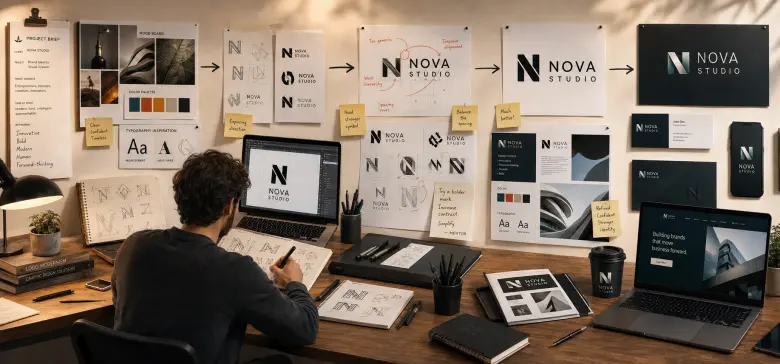
If you (or your parents) want to know exactly what’s inside the course before you commit, here’s the typical curriculum for a serious graphic design fundamentals course in India:
- Typography: Choosing typefaces, hierarchy, kerning, leading, and how type carries meaning.
- Layout and composition: Grid systems, visual balance, white space, and how the eye moves through a page.
- Visual hierarchy: Directing attention through scale, contrast, and position.
- Color theory: Building palettes, understanding contrast, and basic accessibility considerations.
- Image editing: Photo composition and retouching in Adobe Photoshop.
- Vector design: Logos, icons, and scalable graphics in Adobe Illustrator.
- Interface and screen layout: Working in Figma, the tool most design teams in India now use.
- Brief interpretation: Translating a client or assignment brief into design decisions.
- Critique and revision: Receiving feedback and turning it into stronger work.
That’s roughly 60 to 90 contact hours plus 60 to 100 hours of independent project work across three to six months, depending on the program. By the end, a serious student has three to five portfolio pieces and the vocabulary to defend each of their design decisions.
Three Timing Windows for Taking a Design Course in Class 11 or 12
The biggest mistake we see is students waiting until Class 12 to think about this. There are three real windows for taking a graphic design fundamentals course during your senior secondary years. Each has trade-offs. The earliest window is usually the best.
Window 1: After Class 10, During Class 11 (The Strongest Option)
If you’ve just finished Class 10 and you have any interest in design, taking a graphic design course in Class 11 is the smartest play available to you.
Here’s why Class 11 is the strongest window:
- 18 to 24 months of runway before college applications begin to matter
- Lower academic pressure than Class 12, with no Board exam crunch competing for time
- Time to build a complete portfolio for NID, NIFT, Pearl, ISDI, and international design programs
- A clear answer about design fit before the high-stakes Class 12 year begins
- Six to ten hours a week fits comfortably into a Class 11 schedule without sacrificing academics
The math is straightforward. Class 11 is academically lighter than Class 12. You’re not yet under Board exam pressure. You have not committed to a college path. You have 18 to 24 months before applications matter. You can comfortably commit six to ten hours a week to a structured course without sacrificing academic work.
By the end of Class 11 you’ll have a portfolio of real work and, more importantly, a clear answer about whether design is for you. If yes, you can use Class 12 to prepare seriously for NID, NIFT, Pearl, or international design programs with a strong portfolio already in hand. If no, you’ve ruled it out cleanly, you have a transferable skill, and you can spend Class 12 focused on your actual path.
For parents: this is the lowest-risk window because the time investment doesn’t compete with Boards or entrance prep. It’s also the window that gives the family a clear answer before the high-stakes Class 12 year begins.
Window 2: During Class 12 (Tighter but Workable)
Most students who come to us are in this window. It works, but it’s tighter.
The structure that fits: start the course after pre-Boards in Class 12, run it through the four to six months leading up to final Boards, and dedicate weekends to course assignments while weekdays go to Board revision. The course strengthens your portfolio and studio-test readiness for NID-DAT and NIFT entrance processes, which both include hands-on studio evaluations. For students targeting other design programs that accept CUET-Design scores, the visual literacy and portfolio work provide a strong foundation as well.
What this window costs you: less calendar flexibility, more compressed feedback cycles, slightly more stress. What it gives you: a real answer about design before you commit to a degree, and a portfolio for college applications.
Don’t try to start the course during pre-Board exam intensity. Start either right before or right after that window.
Window 3: After Class 12 (Gap Year or First Year of College)
If you missed both earlier windows, the gap year between Class 12 and college is the next-best window. You have more time, you’ve finished Boards, and you have flexibility to commit fully to the course.
The first year of college also works, especially if your college load is moderate and you can carve out six to ten hours a week. We’ve had several students take Graphic Design Fundamentals in their first year of undergrad while figuring out whether to switch to a design path or continue with their original major.
The trade-off in this window: you’re already committed to a path. The course is now about confirming or pivoting rather than exploring from a neutral starting point. Still useful, just less strategically flexible than the Class 11 window.
How a Graphic Design Course Strengthens Your College Application (Even If You Don't Pursue Design)
A focused fundamentals course produces a portfolio of three to five real pieces of design work. That portfolio is useful in three specific ways for college applications, including programs that aren’t strictly design:
- Evidence of initiative outside the standard syllabus. Every Indian and international university now values this. Walking in with a portfolio of work that took six months of disciplined effort lands differently than “I’m interested in design”. It’s evidence.
- A measurable advantage in the studio test at Indian design colleges. NID, NIFT, Srishti, MIT Institute of Design, Pearl, ISDI, and similar institutions weight portfolio work heavily in the studio test and interview rounds. A student walking in with portfolio pieces from a structured course is at a measurable advantage over a candidate who only has entrance-prep coaching.
- A signal of visual literacy for non-design programs. A student applying to liberal arts at Ashoka, business at Symbiosis, or a CS program at IIIT comes across as more substantive when the application package includes actual produced work.
We’ve watched this play out repeatedly with Graphic Design Fundamentals students at AND Academy. The college admissions outcome is almost always net positive, whether or not the student ends up pursuing design further.
Why Graphic Design Skills Are Useful in Any Career, Not Just Design
This part is underrated.
A good graphic design fundamentals course teaches typography, layout, visual hierarchy, color, basic image editing, and the foundational principles of visual communication. Set aside design careers for a moment. These skills show up in almost every field that involves communicating ideas, which is now almost every field.
A medical student who can present research clearly has an advantage in clinical conferences. An economics student who can build a clean case-competition deck wins more case competitions. A future engineer or product manager who understands typography and layout gets to lead on internal communication when nobody else can.
These aren’t hypothetical examples. We’ve seen students who took Graphic Design Fundamentals in Class 11 or 12, decided design wasn’t going to be their career, and still tell us four years later that the skill quietly accelerated everything they did after.
Visual communication is now a baseline literacy. The course pays off whether or not you become a designer.
How to Convince Your Parents About Taking a Design Course (and What to Show Them)

If your parents are skeptical, here’s what to walk them through.
It is not a hobby class.
The Graphic Design Fundamentals course at AND Academy runs across multiple months with real assignments, faculty-led critiques, and a final body of work the student has to defend. It’s structured enough that students sometimes find it hard. That’s the point.
It is not expensive in the way a degree is expensive.
A focused fundamentals course costs a fraction of a single semester at an Indian design college, and a much smaller fraction of a four-year degree abroad. The math is honestly favourable. A small investment in Class 11 or Class 12 produces either a clear “yes I want to pursue this seriously” or a clear “no this isn’t for me”. Both outcomes are valuable.
It is not a binding commitment.
If the student decides three months in that design isn’t for them, the course completes, the portfolio exists, and the student moves on with a useful skill. Nobody has wasted three years.
It is, however, a real introduction to a real field.
Faculty are working designers. Assignments mirror what entry-level designers actually do. There’s no inflated promise that finishing the course makes anyone a designer. It makes them informed.
If you’ve ever wished your child could test a career interest seriously before committing to it, this is the closest thing to that available in India right now. And the earlier they take it (Class 11 ideally), the more time they have to use the answer.
Frequently Asked Questions
I’m in Class 11. Is this too early to take a design course?
The opposite. Class 11 is the strongest window for taking a graphic design fundamentals course. You have lower academic pressure than Class 12, more calendar flexibility, and 18 to 24 months before college applications. Starting in Class 11 means you’ll have a clear answer about design (and a portfolio) before Class 12 begins.
I’m in Class 12 with Boards coming up. Can I still take this course?
Yes, and many students do. Take the course on weekends with assignments due bi-weekly. Start after pre-Boards rather than during the most intense revision window. Six to ten hours a week fits alongside Board prep if you’re disciplined.
Will this course help me get into NID or NIFT?
It will give you a stronger studio test and interview than most candidates, because you’ll have real produced work and you’ll be comfortable defending your design decisions. It’s not a guaranteed admission. But for the studio component specifically, it’s the most efficient preparation you can do. Taking the course in Class 11 gives you the most polished portfolio for NID and NIFT entrance in Class 12.
Is a graphic design course after 12th still worthwhile, or should I have started earlier?
A graphic design course after 12th is still very worthwhile, especially in the gap year before college or in the first year of undergrad. Starting earlier (in Class 11) gives you more strategic flexibility, but starting later still gives you the same skill, portfolio, and clarity about whether design is for you.
I’m interested in Interior Design or UI/UX, not graphic design specifically. Should I still consider Graphic Design Fundamentals?
Yes, in most cases. Visual communication fundamentals (typography, layout, hierarchy, color) underpin all three disciplines. Many students take Graphic Design Fundamentals first specifically because it gives them context to choose between disciplines for their next step.
Do I need to know how to draw?
No. Graphic design is not illustration. Drawing is a useful but not essential skill, and the foundations course does not depend on it.
What software will I learn?
A typical Graphic Design Fundamentals course covers three tools:
- Figma for layout, interface work, and digital design
- Adobe Illustrator for vector design, logos, and icons
- Adobe Photoshop for image editing and photo composition
The course teaches the principles first, then introduces the software as the means of execution. This is the opposite of most YouTube tutorials, which teach software with no underlying principles.
Is this course recognised by colleges?
It’s a certified course from a recognised design education institution. For Indian design colleges, the portfolio you build matters more than the certification on paper. For international applications, the certificate is a credible signal of structured learning outside school.
Key takeaways
If you’re in Class 11 or Class 12 and seriously considering whether design is for you, the Graphic Design Fundamentals course at AND Academy was built for exactly this stage of life. It’s serious enough to test your fit honestly. It’s short enough to layer alongside school. It builds a real portfolio for college applications. And whichever direction you go after, you’ll have learned something that pays off.
You can review the full curriculum, faculty list, and schedule on the Graphic Design Fundamentals course page. You can also book a conversation with our admissions team to walk through whether this is the right next step for you. We’ll be honest about it. If it’s not the right fit, we’ll tell you that too.
Note: All information and/or data from external sources is believed to be accurate as of the date of publication.