




This blog argues that aspiring graphic designers in India should build design judgment before learning software, and explains why AI makes that sequence matter more, not less.
SUMMARISE WITH:


This blog argues that aspiring graphic designers in India should build design judgment before learning software, and explains why AI makes that sequence matter more, not less.
Open YouTube, search "how to learn graphic design", and you'll get the same advice a hundred times over. Download Photoshop. Learn Illustrator. Watch a Figma tutorial. Follow along, make the thing, repeat.
This is how most people in India learn graphic design. It's also why most of them plateau.
The advice isn't wrong, exactly. Software matters. You do need to know your tools. But starting with the tools is like learning to write by memorising a keyboard. You'll be fast at typing and you'll still have nothing to say. The thing that actually makes someone a designer, the judgment about what looks right and why, sits underneath the software, and no tutorial teaches it.
This piece makes the case for learning graphic design the other way around: principles first, software second. It's a contrarian take on how design education usually works in India, and it matters more in 2026 than it did five years ago, because AI has quietly changed which half of the skill actually pays.
Table of Content:
- The Tools-First Trap: Why "Just Learn Figma" Produces Designers Who Can't Get Hired
- What "Design Principles" Actually Means (It's Not Abstract)
- Why Software Tutorials Can't Teach You Judgment
- The AI Reframe: Execution Just Got Commoditised, Judgment Didn't
- How to Actually Learn Graphic Design (Principles First)
- Where the Tools-First Approach Actually Works
- Frequently Asked Questions
The Tools-First Trap: Why "Just Learn Figma" Produces Designers Who Can't Get Hired
Here's a pattern anyone who has reviewed junior design portfolios in India will recognise.
A candidate has spent a year on YouTube. They know Photoshop shortcuts cold. They can rebuild a dribbble shot pixel for pixel. Their Figma file is tidy, their layers are named, their auto-layout is clean. And their work still gets passed over in the first round, because every decision in it is borrowed. The typography is whatever the tutorial used. The colour palette came from a generator. The layout copies a template they admired. Ask them why the headline is that size, or why that button sits where it does, and the honest answer is "because it looked good in the video I followed."
That's the tools-first trap. You can reach a high level of software fluency and a low level of design judgment at the same time, and the gap between them is exactly what hiring managers screen for.
Software fluency is a floor, not a ceiling. It gets you into the room. It does not get you the job. What gets you the job is the ability to look at a blank canvas, understand the problem, and make a hundred small decisions that add up to something that works. None of those decisions live in the software. They live in principles.
What "Design Principles" Actually Means (It's Not Abstract)
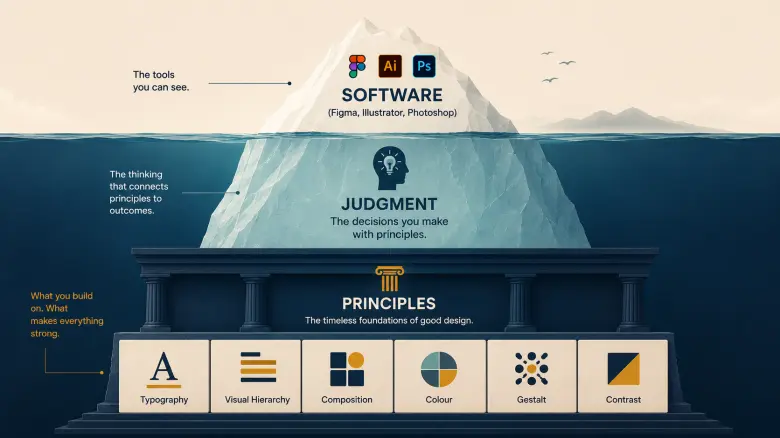
When people hear "learn the principles first," they often imagine something vague and academic. It isn't. Design principles are a concrete, teachable set of tools for making decisions. Here are the ones that do the heavy lifting in graphic design:
- Typography. How type carries tone and meaning. Typeface pairing, hierarchy, kerning, leading, measure. Most weak design is weak because the type is weak.
- Visual hierarchy. Directing the viewer's eye through scale, weight, contrast, and position, so the most important thing is seen first.
- Composition and layout. Grid systems, alignment, balance, and the deliberate use of white space.
- Colour. Building palettes that work, understanding contrast and accessibility, and using colour to structure information rather than just decorate it.
- Gestalt principles. How the eye groups, separates, and reads relationships between elements. Proximity, similarity, continuity, closure.
- Contrast and emphasis. Creating focal points and making sure the design has a clear point of entry.
Notice that not one of these is a software feature. You can learn every one of them with a pencil and paper before you ever open Figma. And once you have them, the software becomes what it should always have been: a way to execute decisions you already know how to make.
This is the reversal at the heart of a principle-first education. You don't learn tools and hope judgment shows up. You build judgment, then pick up tools to express it. AND Academy's Graphic Design Fundamentals course is built on exactly this sequence, teaching the principles first and introducing Photoshop, Illustrator, and Figma as the means of execution rather than the starting point.
Why Software Tutorials Can't Teach You Judgment
There's a specific reason tutorials plateau you, and it's worth naming clearly.
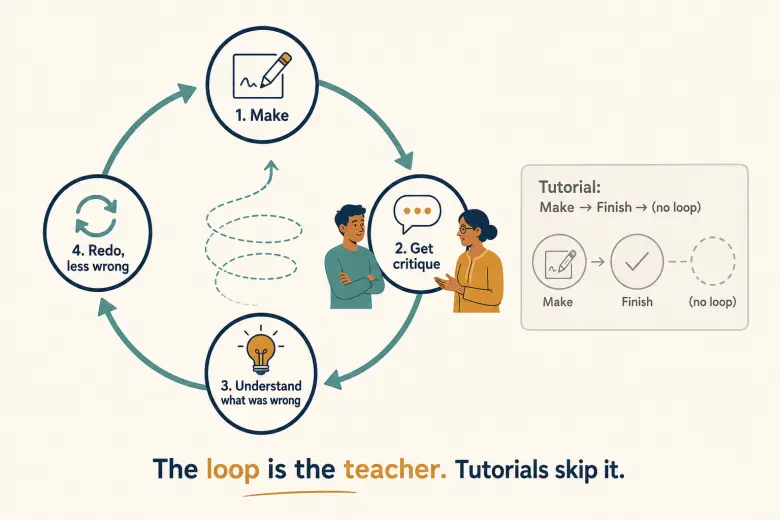
A tutorial can show you what to do. It cannot tell you whether what you did is any good. That second part, the honest assessment of your own work by someone who knows better, is the entire mechanism by which design judgment develops. Designers call it critique, and it's the thing that no video, no course-completion certificate, and no AI tool can give you on its own.
Think about how you actually get better at design. You make something. You think it's good. Someone with more experience looks at it and tells you, in detail, that your hierarchy is muddled, your type is fighting itself, and your third option was stronger than the one you picked. You feel slightly crushed. You fix it. You make the next thing a little less wrong. Repeat that loop two hundred times and you have a designer.
A tutorial removes the loop entirely. You follow along, you produce a copy of the instructor's work, and you never find out whether you could have made those decisions yourself. You mistake the feeling of "I finished the tutorial" for the feeling of "I can design." They are not the same, and the gap between them is invisible until you're sitting in an interview being asked to defend a choice you never really made.
This is why structured learning with real critique beats self-taught tutorial-following for most people. Not because the information is better, but because someone is finally telling you the truth about your work.
The AI Reframe: Execution Just Got Commoditised, Judgment Didn't
Here's why all of this matters more in 2026 than it used to.
For years, software fluency had real market value on its own. If you were fast in Photoshop, you could get paid to be fast in Photoshop, even if your design judgment was thin. Production work, resizing, retouching, laying out variations, all of it rewarded tool speed.
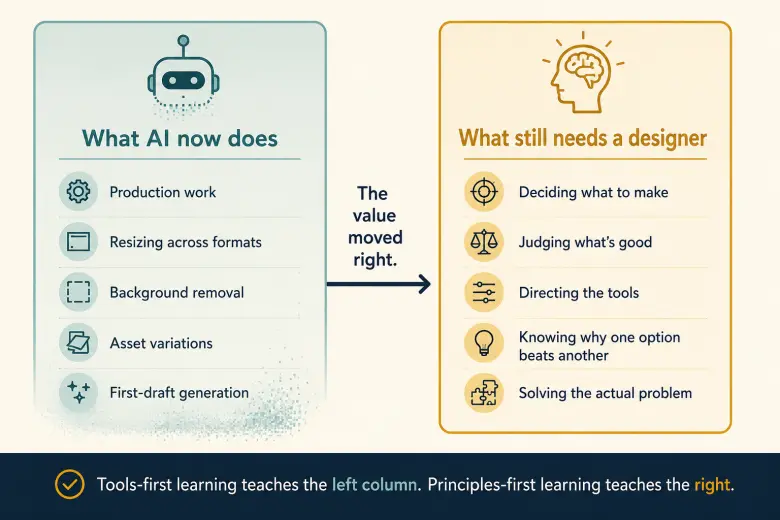
AI has eaten most of that. Generative tools now produce competent first drafts, resize assets across formats, remove backgrounds, generate variations, and handle the production grind that used to be entry-level paid work. The purely mechanical, execution-heavy part of graphic design is being automated fastest, and it's being automated first.
Read that carefully, because it's the whole argument. The half of the skill that tools-first learning teaches is the half AI is absorbing. The half that principle-first learning teaches, the judgment about what to make and why, is the half that's becoming more valuable, not less.
To be fair, AI genuinely helps beginners. It lowers the barrier to producing something that looks passable, and it's a real accelerant for people who already have judgment and want to move faster. That's the honest counter-argument, and it's true. But "looks passable" is exactly the trap. A beginner using AI to skip the judgment-building years will produce work that looks fine and falls apart under the first hard question, the same way the tutorial-follower's work does. The tool got more powerful. The bottleneck didn't move. It's still judgment.
The designers who will do well through this shift are the ones who can direct the tools, evaluate what comes out, and know why one option is better than another. That's a principles skill. It always was.
How to Actually Learn Graphic Design (Principles First)
If you're starting out, or restarting, here's a sequence that respects how judgment actually develops.
Spend your first weeks on principles, not software. Read the foundational texts on typography, layout, and visual thinking. Study why good design works, not just how to reproduce it.
Analyse before you make. Audit designs you admire and designs you don't. For each, ask what decision the designer made and whether it worked. This trains your eye faster than making random things.
Learn one tool well enough to execute, then stop chasing tools. You need working fluency in one layout tool and one image tool. You do not need to master every plugin. Tool-collecting is procrastination dressed as progress.
Get real critique, relentlessly. This is the non-negotiable one. Find a mentor, a structured program, or a serious peer group that will tell you the truth about your work. Without critique, you will plateau at whatever level you can reach alone, which is lower than you think.
Redo your own work. Take something you made three months ago and rebuild it. The gap between the old version and the new one is your judgment developing. If there's no gap, your process is broken.
Treat AI as a junior assistant, not a teacher. Use it to move faster on execution once you have judgment. Do not use it to skip the years that build judgment.
A principle-first path is slower at the start. You won't have a flashy portfolio in three weeks. But you'll have something the tutorial-followers won't: the ability to sit in front of a blank canvas and know what to do.
Where the Tools-First Approach Actually Works
To be fair to the other side, tools-first learning isn't universally wrong, and pretending it is would be dishonest.
Some people genuinely learn well by doing first and understanding later. If you're the kind of person who needs to make something tangible before abstract principles click, starting in the software and reverse-engineering the principles from your own mistakes can work. A few excellent designers came up exactly this way.
There are also roles where tool speed is the main event. High-volume production design, template adaptation, and certain motion and asset-production jobs reward software fluency heavily, and someone optimising for those roles specifically is not making a mistake by going tools-first.
The argument here isn't that software doesn't matter or that everyone must learn in one rigid order. It's that for most people, most of the time, and increasingly so in an AI-shaped market, judgment is the scarce skill and the harder thing to build, so it deserves to come first. If you're going to spend a year learning graphic design, spend the first part of it building the thing that AI can't do for you.
Frequently Asked Questions
Should I learn design principles or software first?
For most people, principles first. You can learn the foundations of typography, hierarchy, composition, and colour with pencil and paper before touching software. Then software becomes a way to execute decisions you already know how to make, rather than a substitute for knowing how to make them.
Is it enough to just learn Figma or Photoshop to become a graphic designer?
No. Software fluency gets you into the room but doesn't get you hired. Hiring managers screen for design judgment, the ability to make and defend decisions, which software fluency alone doesn't build. You need principles plus real critique on top of the tools.
Will AI replace graphic designers?
AI is replacing the execution-heavy, mechanical parts of graphic design (production, resizing, basic asset generation) fastest. It is not replacing the judgment layer, the ability to decide what to make and why. Designers who build strong principles and can direct AI tools are becoming more valuable, not less. Designers whose only skill was tool speed are the most exposed.
How long does it take to learn graphic design properly in India?
A serious foundation takes several months of structured learning, and real competence takes one to two years of practice with critique. Anyone promising you a hireable skill in a few weeks is selling software familiarity, not design judgment.
Do I need a course, or can I self-teach graphic design?
You can self-teach the information. What's hard to self-teach is critique, the honest feedback on your work that actually builds judgment. If you can get that through mentorship or a serious peer community, you can self-teach. If you can't, a structured program is the most reliable way to get it.
If you want to learn graphic design the principle-first way, AND Academy's Graphic Design Fundamentals course is built around exactly this philosophy: foundations first, software as execution, and real critique from working designers at every step. The advanced Graphic Design programs then take those foundations further into specialisation.
You can review the curriculum and teaching approach on the AND Academy Graphic Design course pages. And if you're at the very start of the journey and still deciding whether design is for you, our guide to taking a design course and our breakdown of career options after a graphic design course in India are good next reads.