




Done with an interior design course, or thinking about one? Here's the real picture, with INR numbers, named Indian firms, and an honest read on what's growing in 2026 and what's saturated.
SUMMARISE WITH:


Done with an interior design course, or thinking about one? Here's the real picture, with INR numbers, named Indian firms, and an honest read on what's growing in 2026 and what's saturated.
This guide lists 11 real career options after an interior design course in India, grouped by where you actually go to work each day. For each role we'll show you what the work looks like day-to-day, where graduates from an interior design course are hired in India, the INR salary band by experience level, and our honest assessment of growth potential and ceiling.
Here is a list of things we are going to cover in this blog:
- Why Indian Interior Design Careers Don't Look Like What Most Articles Describe
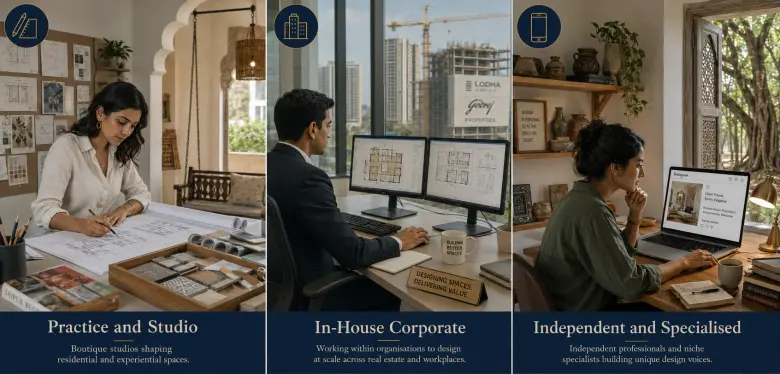
- Practice and Studio Interior Design Careers in India
- In-House Corporate Interior Design Roles in India
- Specialised and Independent Career Paths for Interior Designers in India
- How to Pick Your First Interior Design Job in India
- Interior Designer Salary Progression in India: Year 1 to Year 5
- Frequently Asked Questions About Interior Design Careers in India
Every INR figure here is a range, not a promise. We built these bands from public Indian salary platforms (AmbitionBox, Glassdoor India, Naukri, Payscale India) and checked them against what we've actually seen AND Academy graduates get hired at. Fair warning: the bands lean toward the upper end of the market, meaning established studios, well-funded organised players, and reputable in-house teams. If you start at a small firm, your first salary may land below the floor we show. Every role links to its own salary source. And what you earn will swing a lot based on your city, the firm's reputation, your specialisation, and how strong your portfolio is.
One thing you should know: AND Academy runs interior design courses, and yes, this guide points you toward them where it makes sense. We've kept the salary data sourced and the career commentary straight, including the parts where we tell you a path is saturated or slow-growing. But you deserve to know the commercial angle going in.
Why Indian Interior Design Careers Don't Look Like What Most Articles Describe
Most "career options after interior design" articles on the internet are written for a market that no longer exists. The default template is a list of generic roles (residential designer, commercial designer, set designer, furniture designer) with no INR data, no Indian firms named, and no commentary on which paths are actually growing.
The Indian interior design market in 2026 has shifted in five structurally important ways that those articles haven't caught up with.
First, organised residential interior services (Livspace, HomeLane, Bonito Designs, Design Cafe, Asian Paints Beautiful Homes) have created a new tier of stable, structured entry-level employment for interior design graduates. Ten years ago, an interior design graduate either joined a small boutique studio at low pay or struck out alone. Today, this organised tier hires hundreds of graduates a year with predictable training paths.
Second, real estate developer in-house design teams have expanded rapidly. Lodha, Godrej Properties, DLF, Prestige Estates, Brigade Group, Sobha, K Raheja, and Oberoi Realty all now run sizable internal design teams. The salaries are often higher than equivalent studio roles, and the work is more structured.
Third, visualisation (3D rendering) has gone from a peripheral skill to a near-mandatory one. Strong 3D specialists in 2026 often out-earn generalist interior designers at the same experience level.
Fourth, hospitality interior design has recovered post-pandemic and is now the highest-margin specialty, with strong INR growth and a clear ceiling at the senior level.
Fifth, the small solo decorator role is in decline as organised players absorb that market segment. For a 2026 graduate, that means specialisation matters more than ever.
The 11 roles below are organised around that reality. AND Academy's Interior Design courses are built around current market hiring patterns, with software, portfolio modules, and live project work calibrated to the role categories below.
Practice and Studio Interior Design Careers in India
This is where many graduates still start, and where the deepest craft training happens. Pay is moderate at entry. Variety is high. The work is often the most architecturally ambitious you'll do in your career.
Junior Interior Designer at a Residential Practice
- What you do: Site measurements, AutoCAD or Revit drawings, SketchUp 3D modelling, vendor coordination, client presentations, material selection, and supervised contribution to high-end residential projects.
- Where you work: Indian residential studios such as Khosla Associates, Studio Lotus, Architecture BRIO, Renesa Architecture, RKDS Studio, Karan Desai Architects, Beyond Designs, The Orange Lane, Talati & Partners, and a hundred mid-size residential practices across Indian metros.
- INR range: ₹3 to 6 LPA at smaller studios in year one, ₹4 to 8 LPA at established practices. (Source: AmbitionBox interior designer entry-level)
- Growth trajectory: ₹6 to 12 LPA by year three, ₹12 to 22 LPA by year five as a senior designer or associate. (Source: AmbitionBox senior interior designer,Payscale interior designer India by experience)
- Honest assessment: Most common starting role for interior design graduates in India. Long hours and modest pay at entry, but the craft training is real.
Residential practice rewards patience and observation. You'll spend the first six months mostly on drawings, site visits, and vendor coordination. The design ownership comes after eighteen to twenty-four months. If you're drawn to high-craft residential work and you can tolerate the long apprenticeship, this is the path that produces the best long-term designers.
Commercial / Workplace Interior Designer
- What you do: Design office layouts, workplace strategy, conference rooms, breakout zones, brand integration, and large-format commercial spaces. Heavy collaboration with corporate facility teams and project management consultants.
- Where you work: Commercial design firms (DSP Design Associates, Stapati, Space Matrix, M.Moser Associates, Gensler India, Edifice, Bobby Mukherji Architects, Future Group), and increasingly in-house design teams at large tech and consulting companies in Bengaluru, Hyderabad, Pune, and Gurugram.
- INR range: ₹4 to 7 LPA in year one, often higher at MNC commercial firms. (Source: AmbitionBox interior designer entry-level,AmbitionBox Gensler salary)
- Growth trajectory: ₹8 to 14 LPA by year three, ₹15 to 28 LPA by year five. (Source: Payscale workplace designer India by experience,AmbitionBox senior interior designer)
- Honest assessment: Strong corporate growth path. Hybrid and tech office demand has been a tailwind for this category since 2023. Scales well as you specialise into workplace strategy or large-format commercial.
Workplace design is more structured and less glamorous than residential, but it pays better and the career ladder is clearer. If you're drawn to systems thinking, you enjoy stakeholder management, and you don't need the artistic latitude of residential, this is one of the strongest paths in 2026.
Hospitality Interior Designer
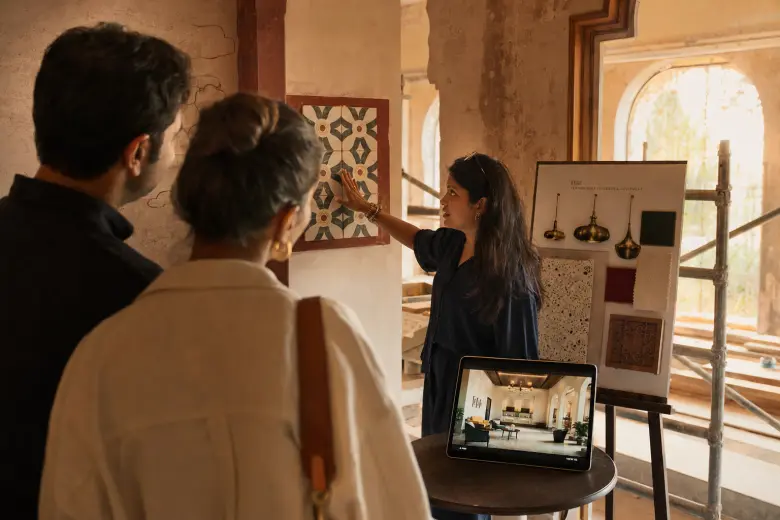
- What you do: Design hotel rooms, restaurants, resorts, lounges, and F&B spaces. Specify FF&E (furniture, fixtures, equipment), coordinate with hospitality operators, and design around guest experience.
- Where you work: Hospitality-focused firms with active India practices (HBA / Hirsch Bedner Associates India, WATG), and in-house design teams at major Indian hospitality groups (Taj Hotels, Oberoi Hotels, ITC Hotels, Marriott India, Hyatt India, IHCL).
- INR range: ₹4 to 8 LPA in year one at hospitality specialists. (Source: AmbitionBox interior designer entry-level,AmbitionBox Taj Hotels salary)
- Growth trajectory: ₹10 to 18 LPA by year three, ₹18 to 35 LPA by year five as a senior hospitality designer. (Source: Glassdoor India senior interior designer,Payscale hospitality designer India by experience)
- Honest assessment: Glamorous but exhausting. Heavy travel, intense project cycles, but the long-term ceiling is the highest in the studio category.
Hospitality design rewards visual storytelling and detail obsession. Project cycles run six to twenty-four months, often with extensive on-site supervision in different cities. If you can tolerate the travel and the long cycles, this path produces some of the most senior creative leadership in Indian interior design.
Visualizer / 3D Specialist
- What you do: Photorealistic renders, animations, walkthroughs, VR-ready models. Use 3DS Max with V-Ray, Lumion, Twinmotion, and increasingly AI-augmented rendering tools.
- Where you work: All interior design studios employ visualizers (often as a separate role from designers), specialised visualisation studios, real estate developers, and freelance practice.
- INR range: ₹3 to 7 LPA at studios in year one, ₹6 to 10 LPA at real estate developers and specialised visualisation firms. (Source: AmbitionBox 3D visualizer entry-level)
- Growth trajectory: ₹8 to 15 LPA by year three, ₹15 to 30 LPA by year five. Strong freelance specialists can exceed this. (Source: AmbitionBox senior 3D visualizer,Glassdoor India interior designer)
- Honest assessment: One of the highest-growth interior design specialties in 2026. Client demand for photorealistic visualisation has exploded with real estate marketing and direct-to-consumer interior services. AND Academy's Interior Design program covers the foundational rendering pipeline; deeper visualisation specialisation typically comes through dedicated post-course practice.
Visualisation rewards technical depth and aesthetic judgement. AI tools are accelerating the throughput, but the strong visualisers are the ones who control composition, lighting, and storytelling, not just the software. If you're technically inclined and you enjoy the craft of image-making, this is the highest-leverage specialisation available right now.
In-House Corporate Interior Design Roles in India
This is where stable INR growth lives. Less glamour than the studio category, more predictability, and often better long-term compensation for the same hours of work.
Real Estate Developer In-House Designer
- What you do: Design sample apartments, sales galleries, model units, common areas, clubhouse interiors, and brand experience spaces for residential and commercial real estate projects. Tight coordination with marketing, sales, and construction teams.
- Where you work: Lodha (the Macrotech Developers parent group), Godrej Properties, DLF, Prestige Estates, Brigade Group, Sobha, Embassy Group, K Raheja Corp, Oberoi Realty, Phoenix Mills, Hiranandani Group, Mahindra Lifespaces.
- INR range: ₹5 to 9 LPA in year one (often higher than studio entry), ₹10 to 18 LPA by year three, ₹18 to 32 LPA by year five. (Source: Payscale India interior designer salary,AmbitionBox real estate developer hiring data)
- Growth trajectory: Structured corporate ladder. Career path to design head of a real estate division is well-defined.
- Honest assessment: Underrated by interior design graduates who are focused on studio glamour. Stable, corporate environment, strong INR growth, predictable hours. Real estate developer in-house roles consistently rank among the stronger first-job choices for interior designers who want a corporate-track career, because the structured growth ladder and INR predictability tend to compound well across the first five years.
Real estate in-house design is the closest thing to a corporate career path interior design has in India. If you value stability, structured growth, and you don't need the prestige of named architects on your business card, this is one of the strongest paths in the field.
Retail Space Designer
- What you do: Design retail store concepts, fixture systems, brand experience zones, visual merchandising integration, and rollout-ready store kits for retail chains and direct-to-consumer brands.
- Where you work: Retail-focused design firms (Four Dimensions Retail Design, Restore Solutions, FRDC), in-house at retail chains and D2C brands (Reliance Retail, Aditya Birla Fashion, Lifestyle, Pantaloons, Tanishq, Caratlane, Nykaa, Mamaearth retail, BoAt experience stores).
- INR range: ₹4 to 7 LPA in year one. (Source: AmbitionBox interior designer entry-level,AmbitionBox Reliance Retail salary)
- Growth trajectory: ₹9 to 15 LPA by year three, ₹15 to 28 LPA by year five. (Source: Payscale retail designer India by experience, Glassdoor India interior designer)
- Honest assessment: The Indian D2C boom has significantly expanded this role. Quick commerce, experiential retail, and brand-land formats have created strong demand. A growth-stage retail design role at a D2C brand can scale fast.
Retail design rewards an understanding of customer behaviour, brand strategy, and operational constraints. The aesthetic is often less ambitious than residential or hospitality, but the business impact is direct and measurable, which gives the path clear career velocity.
Modular Kitchen and Bath Specialist
- What you do: Design modular kitchen layouts, specify cabinetry and hardware, coordinate with manufacturing systems, manage client consultations, and contribute to product-level design for modular furniture brands.
- Where you work: Livspace, HomeLane, Bonito Designs, Design Cafe, Sleek by Asian Paints, Godrej Interio, Hettich India, Hindware Bath Studio, IFB Modular.
- INR range: ₹3 to 6 LPA in year one. (Source: AmbitionBox Livspace interior designer, AmbitionBox HomeLane interior designer)
- Growth trajectory: ₹7 to 13 LPA by year three, ₹12 to 22 LPA by year five. (Source: AmbitionBox Livspace senior designer, Glassdoor India Interior designer salary)
- Honest assessment: High-volume, tech-enabled, systematic work. Often dismissed by interior design graduates as "too templated", but it's an excellent first job for designers who think systematically.
Modular interior services are now one of the largest employers of interior design graduates in India. The work involves real design constraints (modular component limits, manufacturing tolerances, vendor coordination), and the training in design systems and process is valuable even if you eventually move into bespoke practice.
Specialised and Independent Career Paths for Interior Designers in India
These paths usually come later in a career, not at the start. Knowing they exist (and roughly when to consider them) matters for long-term planning.
Set / Exhibition / Event Designer
- What you do: Design sets for film and television, exhibition stalls, event spaces, brand activations, and experiential installations. Project-based intense work with fabrication coordination and tight deadlines.
- Where you work: Production design departments at major Indian film and TV production houses (Yash Raj Films, Dharma Productions, Red Chillies Entertainment, Excel Entertainment, T-Series), exhibition and brand experience firms (Wizcraft, Encompass Events, Showtime Events, Fountainhead MKTG), and freelance project work for OTT productions and live event brands.
- INR range: ₹3 to 7 LPA salaried in year one. Freelance varies dramatically by project and reputation. (Source: Payscale Interior designer salary In India, AmbitionBox exhibition designer)
- Growth trajectory: ₹6 to 14 LPA by year three, ₹12 to 28 LPA by year five. (Source: Payscale production designer India by experience, Glassdoor India set designer)
- Honest assessment: Adrenaline-driven, distinct creative path. Project cycles are short and intense, income is variable in freelance practice, and the work is highly specialised.
Set and exhibition design rewards a specific temperament: comfort with deadlines, fabrication knowledge, and the ability to build large-scale interventions quickly. If you're drawn to this path, plan for two to three years inside an established set or exhibition firm before going independent.
Sustainable / Biophilic Design Specialist
- What you do: Specialise in sustainable material sourcing, biophilic design integration, energy-efficient interior strategies, LEED and GRIHA documentation, and circular design practices.
- Where you work: Sustainability-focused architecture and design firms (Hundredhands, Studio Tiba, Banyan Tree Eco-Architects, Biome Environmental Solutions), in-house sustainability teams at large architecture firms, and increasingly at corporate clients who want certified spaces.
- INR range: ₹4 to 7 LPA in year one.
- Growth trajectory: ₹9 to 15 LPA by year three, ₹15 to 28 LPA by year five.
- Honest assessment: A growing niche that's still small but premium-positioned. Typically requires additional certifications (LEED, GRIHA, WELL) beyond a standard interior design course.
Sustainable design is moving from premium specialisation to baseline expectation in commercial and hospitality work. Designers who specialise here early will be well-positioned for the next decade.
Independent Interior Designer (Solo Practice)
- What you do: Run an independent design practice. Sourcing clients, managing projects end-to-end, coordinating vendors, handling business operations, and producing design work yourself or with a small support team.
- Where you work: Your own practice. Clients sourced through referrals, Instagram presence, design platforms (Houzz India, Pinterest, Behance), and increasingly direct outreach from referrals on completed projects.
- INR range: ₹2 to 5 LPA equivalent in year one of full-time independent practice (unstable). Strong independent practices by year three can reach ₹6 to 18 LPA equivalent. Top independents by year five with established reputation can exceed ₹15 to 40 LPA equivalent. (Source: Payscale India freelance interior designer salary, AmbitionBox independent designer earnings data)
- Honest assessment: High variance. Should not be a first role. The pattern across Indian interior design careers is consistent: designers who go independent within the first two years typically struggle financially and creatively, while those who spend three to five years salaried first build the skill, network, and reputation that make solo practice sustainable.
Independent practice is a craft and a business. The craft you can develop in salaried roles. The business (client acquisition, pricing, scope management, vendor negotiation) you can only develop with time and exposure to real projects. Plan for both.
Studio Founder / Design Entrepreneur
- What you do: Found and lead your own interior design studio. Build the team, manage clients, set the studio's creative direction, run the business operations.
- Where you work: Your own studio. Many of the most respected Indian interior design studios were founded by designers within five to eight years of starting their careers.
- INR range: Year one of founding usually means lower income or break-even. Successful founders within three to five years can pull ₹25 LPA or higher from the business, with significant upside if the studio scales.
- Honest assessment: A five-to-eight year path, not a first-job path. High ceiling, high variance. Indian interior design has produced several globally recognised studio founders, but the path requires both craft maturity and business acumen.
If you're entrepreneurially inclined, plan for it now by paying close attention to studio operations during your salaried years. The Indian interior design studio founders who succeed early tend to share a pattern: they paid close attention to client acquisition, pricing strategy, and team building during their employed years, then applied those lessons when they founded.
How to Pick Your First Interior Design Job in India
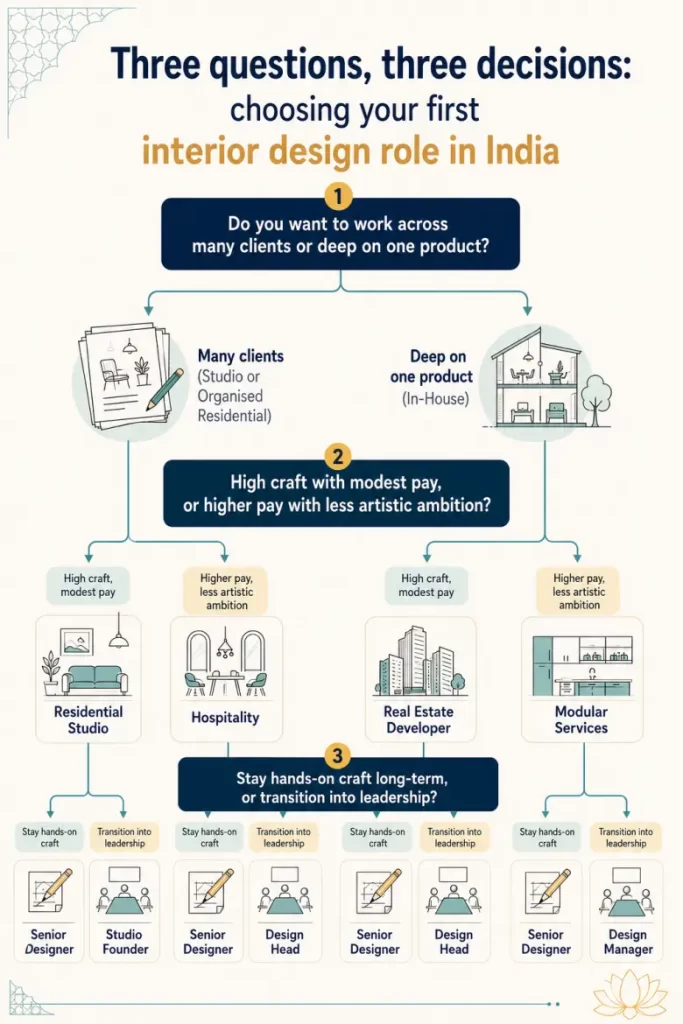
A useful framework for choosing a first interior design role boils down to three questions. Answer them honestly and the right path usually becomes obvious.
- Question 1: Do you want to work across many clients (studio or organised residential) or deep on a few large projects (in-house at real estate, hospitality, retail)? Studios reward variety and design exposure. In-house roles reward depth and the discipline of multi-stakeholder coordination.
- Question 2: Do you want high-craft work with modest pay (residential studio, hospitality, sustainable specialty) or higher-pay structured work with less artistic ambition (real estate in-house, modular services, retail)? Both are real choices. The trade-off is fairly direct in interior design.
- Question 3: Do you want to stay hands-on craft long-term (visualisation, hospitality, residential design), or eventually transition into leadership and project management (commercial, real estate, founding)? Some paths reward technical and aesthetic mastery indefinitely. Others push you toward team and business leadership if you want the salary curve to keep going up.
The honest pattern across Indian interior design careers: graduates do their best work in their first three years by going either deep-residential (for craft) or deep-corporate (for structured growth and INR scale). The graduates who plateau early are usually the ones who tried to stay generalist past year two.
Interior Designer Salary Progression in India: Year 1 to Year 5
A summary of where the curves land. All figures in INR LPA. Ranges are confidence bands synthesised from public Indian salary data on AmbitionBox, Glassdoor India, Naukri, and Payscale India, with role-specific source links in the rightmost column of the table below.
Salary ranges above are confidence bands synthesised from public Indian salary aggregators (AmbitionBox, Glassdoor India, Naukri salary insights, Payscale India), with the specific role-level source for each row linked in the rightmost column. Ranges are not point estimates because interior design compensation in India varies significantly by city tier, firm reputation, and specialisation.
Three patterns stand out across these numbers. First, the year-five spread is large. The same starting point can lead to ₹12 LPA or ₹35 LPA depending on specialisation and the quality of decisions made between years two and four. Second, the highest-growth specialties in 2026 are hospitality, visualisation, real estate in-house, and the commercial / workplace path. Third, the lowest-growth path is the unspecialised generalist track at small residential studios past year two.
One failure pattern worth flagging. Interior designers who stay at small bespoke residential studios without specialising tend to plateau between ₹8 and ₹12 LPA by year four. (Source: AmbitionBox interior designer by experience tier, Payscale interior designer India by years of experience.) If you find yourself in that pattern, course-correct hard. Specialise, build a portfolio in the new specialisation in your evenings, and switch employers.
Frequently Asked Questions About Interior Design Careers in India
Which interior design role pays the most in India?
By year five, the highest-paid paths are:
- Hospitality Interior Designer (senior level): ₹18 to 35 LPA. Source: Glassdoor India senior interior designer, Payscale hospitality designer India.
- Real Estate Developer In-House Designer (senior): ₹18 to 32 LPA. Source: AmbitionBox Lodha salaries, AmbitionBox DLF salaries.
- Visualisation / 3D Specialist (senior or freelance): ₹15 to 30 LPA.
- Commercial / Workplace Designer (senior): ₹15 to 28 LPA. Source: AmbitionBox interior designer, Payscale workplace designer India.
- Independent practice (top tier with reputation): ₹15 to 40 LPA equivalent. Source: Payscale freelance interior designer India, Naukri salary insights.
Hospitality leads at the senior IC level. Independent practice has the highest ceiling but the highest variance.
Salary ranges in this answer are synthesised from public Indian salary data on AmbitionBox, Glassdoor India, Naukri salary insights, and Payscale India. Per-role source links are given alongside each bullet above. Figures are confidence bands, not single-point averages, because Indian interior design compensation varies significantly by city, firm tier, and specialisation.
Is interior design a good career in India in 2026?
Yes, with a caveat. Interior design as a generalist residential career has tighter economics than it did ten years ago. Interior design with a clear specialisation (visualisation, hospitality, real estate in-house, sustainable, commercial workplace, or modular services) is a strong career with multiple paths to ₹20 LPA and above by year five. (Salary band sourced from Payscale interior designer India and AmbitionBox senior interior designer.)
Which Indian companies and studios hire interior designers?
Active hirers in 2026 include residential studios (Khosla Associates, Studio Lotus, Architecture BRIO, Renesa, Beyond Designs), commercial firms (DSP Design Associates, Stapati, M.Moser Associates, Gensler India), hospitality (HBA India, WATG, Taj, Oberoi, ITC Hotels, Marriott India, Hyatt India, IHCL), real estate developers (Lodha, Godrej Properties, DLF, Prestige, Brigade, Hiranandani, Mahindra Lifespaces), organised residential services (Livspace, HomeLane, Bonito Designs, Design Cafe), modular brands (Sleek, Godrej Interio, Hettich, IFB), and retail and D2C (Reliance Retail, Aditya Birla Fashion, Tanishq, Caratlane, Nykaa).
Should I freelance straight out of an interior design course?
We strongly recommend against it. Spend three to five years salaried first to build skill, network, and reputation, then go independent from a position of strength. The pattern is consistent: independent designers who started salaried earn significantly more and have more stable practices than those who went independent from the start.
How is AND Academy's Interior Design course structured to prepare for these career options?
AND Academy's Interior Design programs cover the software (AutoCAD, SketchUp, Coohom), the technical drawing and detailing standards Indian firms expect, material and finish knowledge, lighting design, and portfolio modules calibrated to specific role types (residential, commercial, hospitality). The advanced program also includes a live project module that gives graduates work products to show in interviews. Our portfolio review process aligns the case studies you build with the specific role you're applying for.
Can I move into UI/UX design from interior design?
Yes, but it requires significant retraining. Spatial design thinking transfers well, but the software, interaction patterns, and digital portfolio expectations are entirely different. The cleanest path is to take a structured UI/UX course after two to three years of interior design practice, treating it as a sideways specialisation rather than a complete pivot.
Highest paying interior design jobs in India: where should a new graduate aim?
For year-one income, the strongest options are real estate developer in-house roles (₹5 to 9 LPA) and well-funded organised residential services (₹4 to 8 LPA at HomeLane, Livspace, Bonito Designs). For the highest long-term ceiling, hospitality and independent practice lead, but both require patience and several years of salaried experience first. (Salary data sourced fromAmbitionBox, Glassdoor India, and Payscale India.)
If you've finished an interior design course (or are choosing one) and you want to build a portfolio aimed at any of the eleven roles above, AND Academy's Interior Design courses are built around the role-specific portfolio work each path requires. Our advanced Interior Design program covers residential, commercial, and hospitality specialisation in depth, with software training (Coohom, SketchUp, AutoCAD) and live project work integrated throughout.
You can review the curriculum, faculty list, and role-specific portfolio modules on the AND Academy Interior Design program page. You can also book a fifteen-minute conversation with our admissions team to map a career path based on which of these eleven roles you're drawn to. We'll be honest about which paths fit your background, your timeline, and your goals.